
Menu
Organic social and paid advertising work better together than they do in isolation. When the content your audience sees organically reinforces the ads they're served — with consistent messaging, creative and calls to action — the customer journey feels coherent and the results of both channels improve.
Funnel alignment with paid ads creates that connection. It defines how your organic social content supports your paid campaigns, ensures the messaging is consistent across both, and builds a coordinated approach that makes your marketing spend work harder by reducing the gap between awareness and conversion.
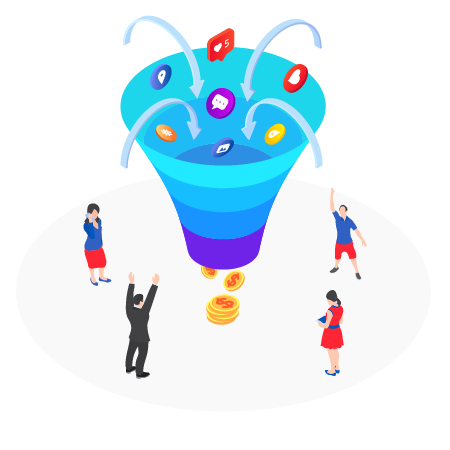
Funnel alignment with paid ads is the process of ensuring a business’s organic social media content and its paid advertising campaigns are working towards the same goals with consistent messaging. It maps the relationship between organic content and ad creative at each stage of the customer journey — awareness, consideration and conversion — and defines how the two channels should complement each other to create a more coherent and effective overall social media presence.
You need this when paid social is part of your strategy and your ad creative isn’t performing, when click-through rates are low or your cost per result is too high, or when you want to develop a library of social ad formats and variants to test systematically. Social creative that stops the scroll is the most important variable in any paid social campaign.
This service includes the concept, copywriting and design of social ad creative across defined formats and platforms. Covers static images, carousel formats, video and story ads as required. Delivered as a social ad creative package with multiple variants for testing, sized and formatted for each required platform.

Most marketing companies focus on channels and tactics.
We focus on reaction.
Before selecting platforms, formats, or media spend, we define how your audience thinks, feels, and decides. We use behavioural psychology to understand what will capture attention, build trust, and motivate action — then choose the channels that best support that outcome.
Every channel we use has a clear purpose, a defined role, and a measurable objective. Nothing is done “because it’s popular” or “because it’s expected”.
The result is marketing that feels natural to engage with, works across multiple channels, and is designed to deliver meaningful, long-term results.
Want to see how this approach works in practice?
The strategic integration of organic social content and paid social ads so that each serves a distinct role in the buyer journey — organic building awareness and credibility with warm audiences while paid advertising targets cold audiences and amplifies conversion-focused messages.
Organic content builds the brand’s social proof, demonstrates expertise and warms up audiences over time. Paid ads can then target people who have engaged with organic content (retargeting) or reach entirely new audiences with commercial messages. Each discipline strengthens the other.
A custom audience of people who have previously engaged with your organic content (watched a video, liked a post, visited your profile) or your website. Retargeting these warm audiences with paid ads is significantly more cost-effective than targeting cold audiences with the same message.
By identifying organic posts that have already demonstrated strong engagement — high save rate, strong comment engagement, high click-through — and promoting them as ads. Posts that have already proven organic resonance are lower-risk paid investments.
Top-of-funnel content introduces the brand and educates new audiences (typically organic or awareness-level paid). Bottom-of-funnel content presents specific offers, case studies or product demonstrations to people already aware of the brand (typically retargeting paid).
By planning content types for each funnel stage across the month — ensuring awareness, consideration and conversion content are all represented, and that content planned for paid amplification is identified in advance so production standards and messaging are appropriate.
A brand awareness campaign optimises for reach and impressions — getting the brand in front of as many relevant people as possible. A conversion campaign optimises for a specific action (form completion, purchase, app download) and targets audiences more likely to take that action.
Partially. Organic content can track engagement (top-of-funnel) and link clicks (mid-funnel). Conversion tracking (bottom-of-funnel) requires a paid campaign structure with proper pixel and event tracking. A full funnel view requires both organic engagement data and paid conversion data.
Allocate a larger share of budget to awareness and consideration stages for a growing brand building a new audience, shifting more to conversion and retargeting as the warm audience pool grows. The ratio evolves as the social audience and brand recognition develop.
A framework describing how a potential customer moves from first encountering the brand (awareness) through evaluating it (consideration) to making a purchase decision (conversion). Social media content and advertising are planned at each stage to guide people through this journey rather than treating all content as single-purpose posts.
This website uses cookies to improve your experience. Choose what you're happy with.
Required for the site to function and can't be switched off.
Help us improve the website. Turn on if you agree.
Used for ads and personalisation. Turn on if you agree.