
Menu
Every DOOH screen provider operates to different technical specifications — different dimensions, frame rates, file sizes, colour profiles and file formats. Creative that works perfectly in one environment may be rejected or display incorrectly in another.
Screen specification formatting ensures your DOOH creative meets the exact requirements of every screen it's destined for. Accurate, compliant, and delivered to the standards that providers require — so nothing gets rejected and nothing displays in a way that undermines the impact of your campaign.
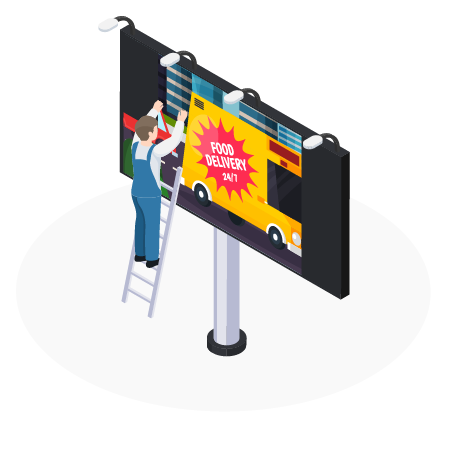
Screen specification formatting is the technical process of preparing DOOH creative files to meet the exact technical requirements of each digital screen operator or network. Different screens require different file formats, dimensions, frame rates, file sizes and colour profiles — and this service ensures every piece of artwork is correctly prepared before submission, preventing rejection or incorrect display.
You need this when you’re planning a campaign that spans both print and digital, when the design needs to look consistent across formats, or when you need creative assets that can be adapted from a single master design rather than produced separately for each medium. Integrated print and digital creative saves time, reduces inconsistency and ensures the campaign has a coherent visual identity across every touchpoint.
This service includes the design of campaign assets for both print and digital channels from a single creative concept, ensuring visual consistency across all formats. Covers artwork adaptation for each required format, print-ready and digital-ready file preparation. Delivered as a complete campaign asset suite for both print and digital application.

Most marketing companies focus on channels and tactics.
We focus on reaction.
Before selecting platforms, formats, or media spend, we define how your audience thinks, feels, and decides. We use behavioural psychology to understand what will capture attention, build trust, and motivate action — then choose the channels that best support that outcome.
Every channel we use has a clear purpose, a defined role, and a measurable objective. Nothing is done “because it’s popular” or “because it’s expected”.
The result is marketing that feels natural to engage with, works across multiple channels, and is designed to deliver meaningful, long-term results.
Want to see how this approach works in practice?
The process of producing DOOH advertising artwork in the exact pixel dimensions, file format, frame rate, loop duration and technical settings required by each specific screen operator and placement — ensuring the creative displays correctly on the intended screens.
Because screens vary significantly in physical dimensions, display resolution, content management systems and technical capabilities. A creative file built for one operator’s billboard may not display correctly on another’s.
Pixel dimensions, aspect ratio, file format, maximum file size, frame rate and loop duration for motion, colour profile requirements and content delivery method (upload portal, FTP or physical delivery).
The artwork may be rejected by the operator’s content management system, display incorrectly (cropped, distorted or pixelated) or fail to upload. Incorrect specifications must be corrected and resubmitted, creating timeline pressure.
Not usually. Most campaigns require multiple versions produced to different specifications. A campaign planned across multiple operators should account for this in the production brief.
Static JPG and PNG files are typically under 2MB. Motion MP4 files are typically under 10–50MB depending on loop length. Export settings should be optimised for the operator’s specified limits.
Most operators require artwork to be submitted 24 to 72 hours before the campaign start date. Static bookings have fixed submission deadlines that must be factored into the production schedule.
Yes, for digital placements. One of the key advantages of DOOH over static print outdoor is the ability to update content remotely. Changes may be subject to the operator’s content review process and a minimum notice period.
The platform the media owner uses to schedule and display content on its screen network. Artwork formatted correctly for the CMS is uploaded directly. Incorrectly formatted files are flagged by the CMS before going live, requiring correction.
The advertiser or their agency. The media owner will confirm receipt and technical validity of the submission but is not responsible for artwork quality or compliance with their specification if that information was shared in advance.
This website uses cookies to improve your experience. Choose what you're happy with.
Required for the site to function and can't be switched off.
Help us improve the website. Turn on if you agree.
Used for ads and personalisation. Turn on if you agree.