
Menu
The most effective email marketing doesn't rely on someone remembering to hit send. It runs in the background — nurturing prospects, welcoming new subscribers, recovering abandoned carts, and re-engaging lapsed customers — all without ongoing manual effort.
Funnel and automation mapping designs that system. It identifies the key moments in your customer journey, defines what should happen at each stage, and lays out the automated flows that make your email programme work for you around the clock.


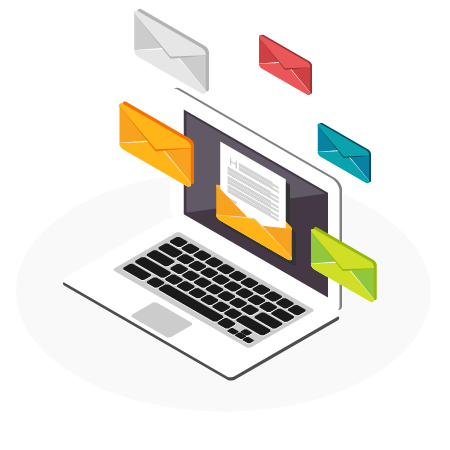
Funnel and automation mapping is the process of designing the automated email journeys that guide contacts through your customer lifecycle. It identifies the key trigger points — sign-ups, purchases, inactivity, page visits — and maps out the sequences of emails that should follow each one, defining the content, timing and logic that make each automated flow work.
You need this when you’ve built a subscriber list but send emails infrequently or inconsistently, when your email open and click rates are declining, when your content lacks direction or a clear audience purpose, or when you’re investing in email marketing without a clear strategic rationale behind what you’re sending and why. A well-defined strategy gives your email activity direction and measurable goals.
This service includes the strategy, copywriting and design of a multi-step automated email sequence for leads who are not yet ready to buy. It covers content mapping by buying stage, email copywriting and design, personalisation where appropriate and platform setup. Includes performance tracking setup. Delivered as a live, automated nurture programme.

Most marketing companies focus on channels and tactics.
We focus on reaction.
Before selecting platforms, formats, or media spend, we define how your audience thinks, feels, and decides. We use behavioural psychology to understand what will capture attention, build trust, and motivate action — then choose the channels that best support that outcome.
Every channel we use has a clear purpose, a defined role, and a measurable objective. Nothing is done “because it’s popular” or “because it’s expected”.
The result is marketing that feels natural to engage with, works across multiple channels, and is designed to deliver meaningful, long-term results.
Want to see how this approach works in practice?
A lead nurture sequence is a series of automated emails designed to build a relationship with prospects who are interested but not yet ready to buy — providing relevant content, building trust and keeping your brand front of mind until the prospect is ready to make a decision.
A newsletter goes to all subscribers and is typically content-led. A nurture sequence is triggered by a specific behaviour or signal — a download, a form fill, a product page visit — and is tailored to guide a specific audience segment toward a specific action.
The length should reflect your typical sales cycle. For businesses with a one-week sales cycle, a short, intensive sequence may be appropriate. For those with a six-month cycle, a longer, more spread-out programme is more fitting.
Content that addresses the questions, concerns and objections prospects have at different stages of the buying journey — case studies, thought leadership, proof points, comparison content and answers to the objections your sales team hears most often.
Even a small volume of leads benefits from a structured nurture programme. The sequence is built once and runs automatically, so the cost of operating it doesn’t increase with lead volume.
Yes. Segmented nurture sequences that deliver content relevant to a specific industry, audience type or use case consistently outperform generic sequences. If your leads come from different segments, separate sequences for each will improve results.
Low engagement may indicate the content isn’t relevant, the timing isn’t right or the lead wasn’t well-qualified. A re-engagement step at the end of the sequence can test whether the prospect is still interested before removing them from active nurture.
Yes, but progressively. Early emails in the sequence should focus on delivering value and building trust. Commercial calls to action become more appropriate as the sequence progresses and the relationship has been established.
CRM integration allows nurture sequences to be informed by sales activity — pausing the sequence when a salesperson is in active conversation, adjusting content based on what’s been discussed, and triggering follow-up sequences based on deal stage.
Track email engagement metrics at each step of the sequence, measure the conversion rate from lead to opportunity, compare the close rate and deal value of nurtured versus non-nurtured leads, and calculate the revenue attributable to the nurture programme.
This website uses cookies to improve your experience. Choose what you're happy with.
Required for the site to function and can't be switched off.
Help us improve the website. Turn on if you agree.
Used for ads and personalisation. Turn on if you agree.